Calculator
IBR calculator: your Income-Based Repayment payment, with the formula shown.
IBR charges 10% of your discretionary income, the part of your adjusted gross income above 150% of the poverty guideline, and never more than the 10-year Standard payment. Enter your income and loans once and the calculator ranks IBR against RAP, PAYE, ICR and Standard on your numbers.
Rank every plan for me, free Ten questions, two minutes, your own numbers.
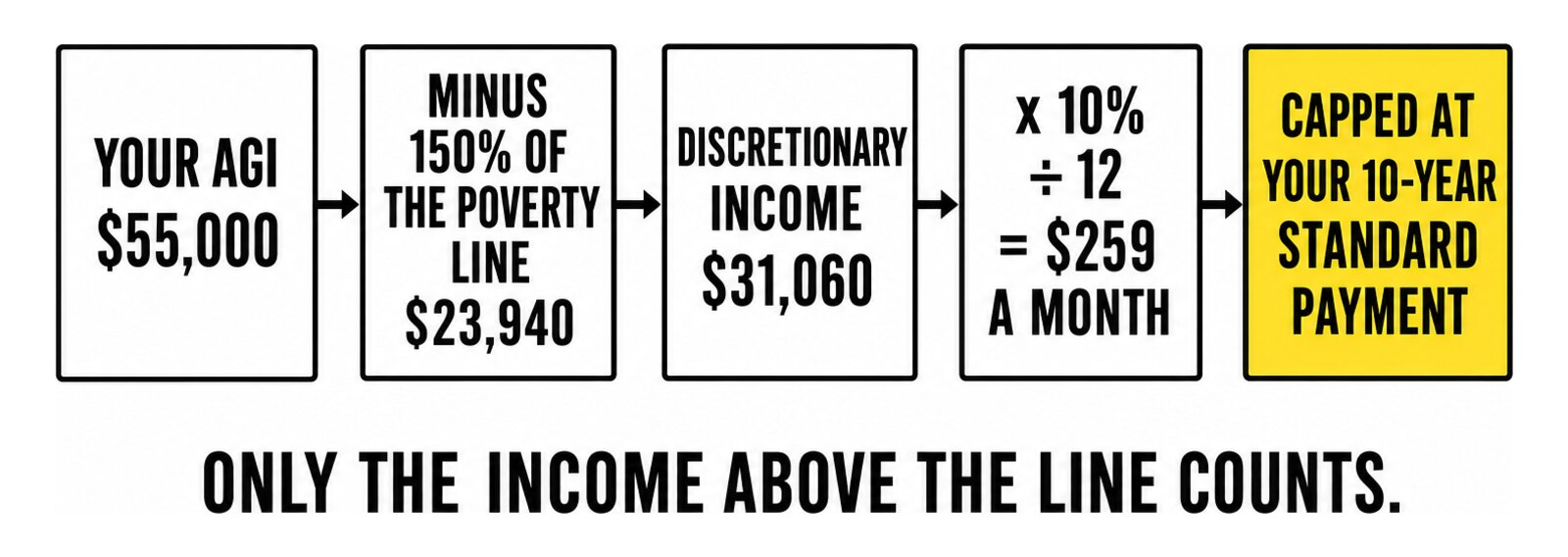
The formula
- Step 1, discretionary income
- Adjusted gross income minus 150% of the 2026 poverty guideline for your family size. Below that line, the payment is $0.
- Step 2, the share
- 10% of discretionary income if your first federal loan was made on or after July 1, 2014; 15% if earlier. Divide by 12.
- Step 3, the cap
- The payment never exceeds what the 10-year Standard plan would charge on the balance you had when you enrolled.
- No hardship test
- Since July 1, 2026 the partial financial hardship requirement is gone: any eligible borrower can enroll, whatever the income.
- Married
- Filing separately counts only your income. Filing jointly counts both, and the payment is split by balance when both spouses have federal loans.
The 2026 poverty line, and 150% of it
| Family size | Poverty guideline | 150%, the IBR line |
|---|---|---|
| 1 person | $15,960 | $23,940 |
| 2 people | $21,640 | $32,460 |
| 3 people | $27,320 | $40,980 |
| 4 people | $33,000 | $49,500 |
48 contiguous states and D.C. Alaska and Hawaii use higher guidelines; the app applies them when you pick your state.
Four borrowers, the IBR payment next to the rest
| Borrower | IBR a month | RAP a month | Standard a month | #1 plan | All in on #1 |
|---|---|---|---|---|---|
| $38,000 income, $27,000 in loans | $117 | $95 | $307 | Standard 10-year | $36,790 |
| $46,000 income, $58,000 in loans | $184 | $153 | $659 | Income-Based Repayment | $78,746 |
| $55,000 income, $48,000 in loans | $259 | $229 | $545 | Standard 10-year | $65,404 |
| $85,000 income, $95,000 in loans | $509 | $567 | $1,079 | Standard 10-year | $129,445 |
Assumes single, a family of one, first loan after July 1, 2014, a 6.5% rate, no public service, income rising 3% a year with the poverty line following the CBO inflation forecast (the studentaid.gov calculator's assumptions), and a 22% tax on any taxable forgiveness. Monthly figures are the first year: income-driven payments are recalculated from income every year, Graduated steps up every two years, Standard and Extended stay fixed. Your own numbers change the order.
The formula with one borrower's numbers
$55,000 income, $48,000 in loans, single, family of one.
- Income that counts
- $55,000 Your adjusted gross income, line 11 of your return.
- Poverty guideline, family of 1
- $15,960 2026 HHS guideline.
- Protected income
- $23,940 150% of $15,960.
- Discretionary income
- $31,060 $55,000 − $23,940
- Per year
- $3,106 $31,060 × 10%
- Per month
- $259 $3,106 ÷ 12
- 10-year Standard cap
- $545 Your income-based figure is under the cap.
- Your payment
- $259 Recalculated every year from your return.
What a payment formula cannot tell you
The cap is set on the way in
The Standard amount that caps your IBR payment is computed on your balance when you enroll. Paying the balance down before you switch lowers the cap for good.
Leaving IBR capitalizes interest
Switching from IBR to any other plan adds unpaid interest to your principal. Moving into IBR does not. Pick once.
Forgiveness after 20 or 25 years, taxed
New-borrower IBR forgives after 240 payments, older loans after 300. The forgiven balance is taxable income that year unless it comes through PSLF.
Interest is not waived
Unlike RAP, interest your IBR payment does not cover keeps accruing. The ranking shows what that does to the balance by year.

Your income, your loans, every plan.
The free ranking runs IBR, RAP, PAYE, ICR and Standard on your numbers, month by month, with the math shown. Every position is free, with the math; the kit with the pre-filled form is $29.
Rank my plans, freeSources
- Income-driven repayment plans Federal Student Aid
- 34 CFR 685.209, income-driven repayment plans Code of Federal Regulations
- 2026 poverty guidelines HHS, ASPE
- Top FAQs about income-driven repayment plans Federal Student Aid
- IBR vs RAP Tate Law
- Switching between IBR and RAP Tate Law