Leaving SAVE
SAVE is ending. Here is what to do in your 90 days.
The notice, the deadline, what happens if you do nothing, the plans you can still pick, and what the default costs four real borrowers.
Rank every plan for me, free Ten questions, two minutes, your own numbers.
What happens, in order
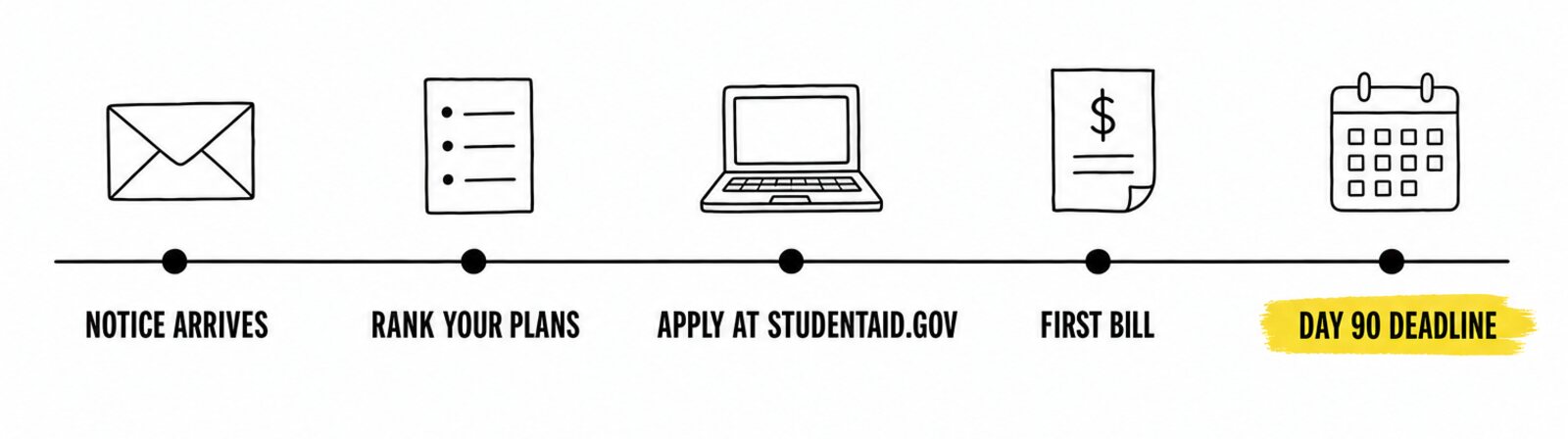
- Your servicer sends a notice. They started on July 1, 2026 and are sending them in waves into 2027, by email or by mail. The date on yours is the date that matters.
- You have 90 days from that date to choose a new plan. Nobody is moved before September 29, 2026, the first wave's deadline.
- You apply at studentaid.gov (income-driven plans: the IDR Plan Request) or with your servicer (Standard, Graduated, Extended). Both are free. Consent to the IRS data share and the application is processed faster and recertifies on its own.
- If you do nothing, you are placed on the Standard plan, or Tiered Standard for loans made on or after July 1, 2026. For most SAVE borrowers that is the highest monthly payment on the list.
The dates that matter
- August 1, 2025
- Interest started accruing again in the SAVE forbearance. The months since earn no credit toward forgiveness or PSLF.
- July 1, 2026
- Notices began. RAP opened. Loans made on or after this date can only use RAP or the Tiered Standard plan.
- September 29, 2026
- The first wave of 90-day deadlines. Yours is 90 days from the date on your own notice.
- September 30, 2026
- Last day to enroll in auto pay for the 1 point interest rate reduction that runs through June 30, 2028.
- July 1, 2028
- PAYE and ICR close. Anyone still on them must move to RAP or IBR.
What the default costs
The same engine that ranks your plans, run for four borrowers. The Standard plan is what you get by doing nothing; the #1 plan is what the ranking picks on all-in cost.
| Borrower | Standard a month | Standard all in | #1 plan | #1 a month | #1 all in | Difference |
|---|---|---|---|---|---|---|
| $38,000 income, $27,000 in loans | $307 | $36,790 | Standard 10-year | $307 | $36,790 | Standard is #1 |
| $46,000 income, $58,000 in loans | $659 | $79,029 | Income-Based Repayment | $184 | $78,746 | $283 less |
| $55,000 income, $48,000 in loans | $545 | $65,404 | Standard 10-year | $545 | $65,404 | Standard is #1 |
| $85,000 income, $95,000 in loans | $1,079 | $129,445 | Standard 10-year | $1,079 | $129,445 | Standard is #1 |
Assumes single, a family of one, first loan after July 1, 2014, a 6.5% rate, no public service, income rising 3% a year with the poverty line following the CBO inflation forecast (the studentaid.gov calculator's assumptions), and a 22% tax on any taxable forgiveness. Monthly figures are the first year: income-driven payments are recalculated from income every year, Graduated steps up every two years, Standard and Extended stay fixed. Your own numbers change the order.
The plans you can still pick
- Repayment Assistance Plan (RAP)New, since July 1, 2026The new income-driven plan: a share of your whole income, unpaid interest waived, forgiveness after 30 years.
- Income-Based Repayment (IBR)Open, permanent for loans made before July 202610% or 15% of discretionary income, capped at the Standard payment, forgiveness after 20 or 25 years.
- Standard 10-yearThe default when you choose nothingThe same payment every month for ten years. Where SAVE borrowers land if they choose nothing.
- Graduated 10-yearOpenStarts low, rises every two years, paid off in ten. No PSLF credit.
- Extended 25-yearOpen, for more than $30,000 in Direct LoansA lower fixed payment stretched over 25 years. The most interest of any plan, no PSLF credit.
- Pay As You Earn (PAYE)Closing: ends by July 1, 202810% of discretionary income with a 20-year clock, for borrowers already on it.
- Income-Contingent Repayment (ICR)Closing: ends by July 1, 2028The only income-driven plan for consolidated Parent PLUS loans; 20% of discretionary income or a 12-year fixed amount, whichever is less.
- Tiered StandardNew, for loans made on or after July 1, 2026A fixed payment whose term depends on your balance: 10, 15, 20 or 25 years.
Two traps
Consolidating first
IBR: Direct and FFEL loans made before July 1, 2026. The partial financial hardship test was removed by the 2025 law, so nearly everyone with eligible loans qualifies, though some servicer tools still show "not eligible"; the paper form is the way through when that happens. Parent PLUS loans are excluded. A new loan or consolidation on or after July 1, 2026 removes IBR access.
RAP: Direct Loans, including Direct Consolidation Loans. FFEL and Perkins loans must be consolidated first. Parent PLUS loans and consolidation loans that repaid Parent PLUS are excluded. For any loan made on or after July 1, 2026 it is the only income-driven plan.
Waiting for the notice
Interest has run in the forbearance since August 1, 2025, and those months count toward nothing. You do not need the notice to rank your plans or to apply. Apply when the payment fits your budget; the sooner you are on a qualifying plan, the sooner the clock toward forgiveness or PSLF runs again.

Know your #1 plan before the notice arrives.
Ten questions, every federal plan ranked with your own numbers, the math shown. Every position is free, with the math; the kit to switch, with the guide, the form and the dates, is $29.
Rank my plans, freeSources
- Next steps for borrowers enrolled in the SAVE Plan (press release) U.S. Department of Education
- Court actions and the end of SAVE Federal Student Aid
- Interest resumes for SAVE borrowers on August 1, 2025 (press release) U.S. Department of Education
- 1 percent auto pay interest rate reduction (press release) U.S. Department of Education
- Lower or suspend your payments, with the auto pay note Federal Student Aid
- Auto pay interest rate reduction MOHELA
- ED announces temporary 1% interest rate reduction NASFAA
- FAQs, including the SAVE notice window Edfinancial
- Repayment plan FAQs Nelnet
- Top FAQs about income-driven repayment plans Federal Student Aid
- Public Service Loan Forgiveness Federal Student Aid
- The SAVE plan is gone: how to pick your next plan Tate Law
- PSLF changes in 2026 Tate Law
- 2026 poverty guidelines HHS, ASPE
- Topic 456, student loan interest deduction IRS