Married borrowers
Married with student loans: file jointly or separately before you pick a plan.
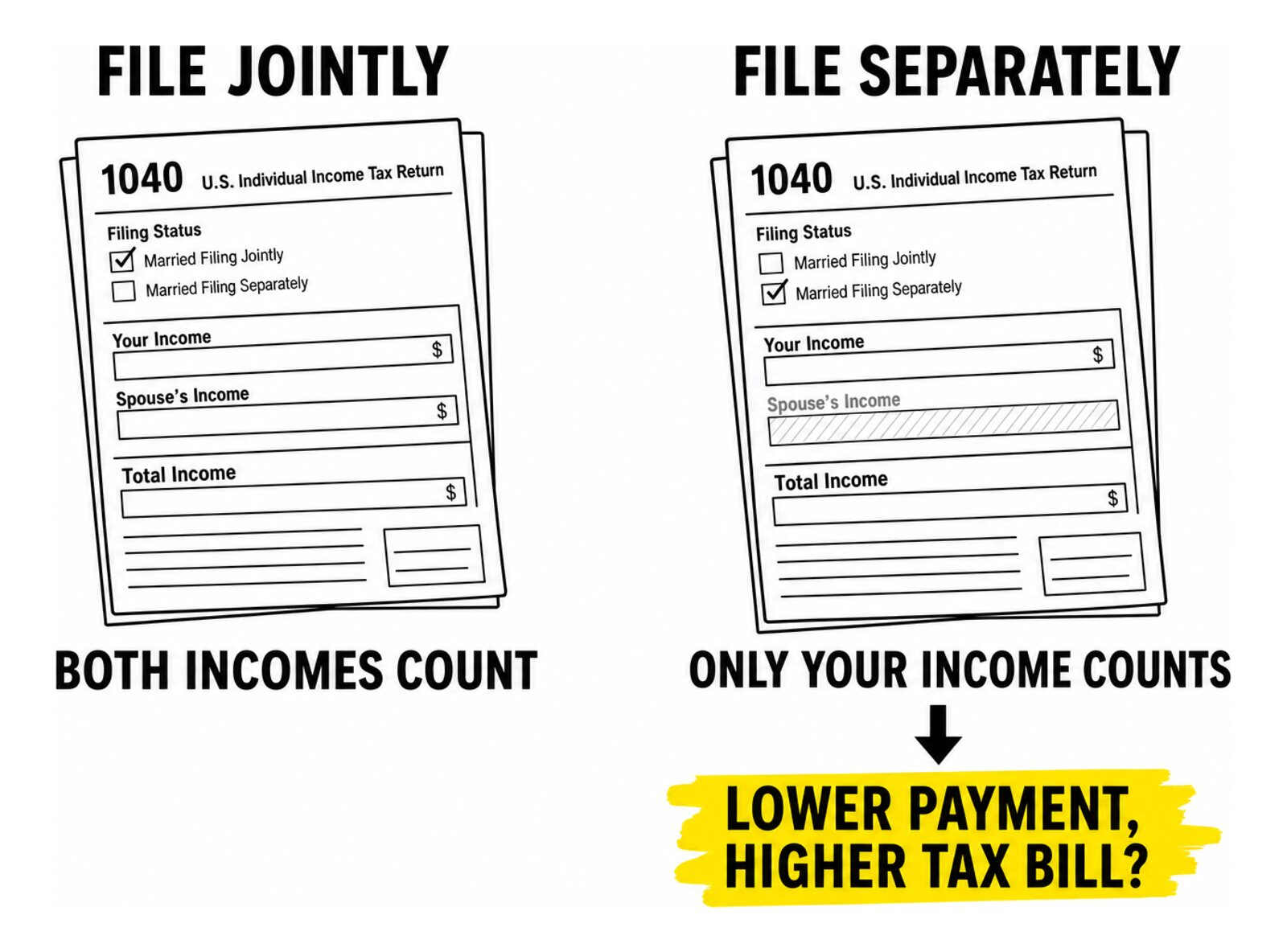
On an income-driven plan, the tax return you file decides whose income counts. The same couple can get two very different payments.
Rank every plan for me, free Ten questions, two minutes, your own numbers.
The rule, plan by plan
RAP
A share of your adjusted gross income, not of discretionary income: 1% for AGI between $10,001 and $20,000, then one point more for each $10,000 bracket, up to 10% above $100,000. AGI at or under $10,000 pays $10. Subtract $50 a month for each dependent child. Never under $10. Married filing separately counts only your AGI, not your spouse's; filing jointly counts both incomes.
IBR
10% of discretionary income if your first federal loan was made on or after July 1, 2014 ("new borrower" IBR), 15% if earlier. Discretionary income is adjusted gross income minus 150% of the poverty guideline for your family size. The payment never exceeds the 10-year Standard amount set when you enroll. Married filing separately counts only your income, not your spouse's; filing jointly counts both.
Three couples, both ways
The income-driven payment when the couple files jointly, then when the borrower files separately. Same loans, same incomes, a different return.
| Couple | IBR, jointly | IBR, separately | RAP, jointly | RAP, separately |
|---|---|---|---|---|
| $60,000 and a spouse at $60,000, $50,000 in loans | $568 | $230 | $1,000 | $250 |
| $45,000 and a spouse at $90,000, $70,000 in loans | $795 | $105 | $1,125 | $150 |
| $80,000 and a spouse at $40,000, $40,000 in loans | $454 | $396 | $1,000 | $467 |
Assumes a household of two, no children, first loan after July 1, 2014, a 6.5% rate, no public service, income rising 3% a year. The lower payment is not the whole story: filing separately usually raises the couple's federal tax and removes some credits and deductions, so the kit shows both numbers and says when to ask a tax preparer.

Run it both ways with your own numbers.
The questions ask how you file and what your spouse earns, then rank every plan under both returns. Every position is free, with the math; the kit, with the filing comparison written down, is $29.
Rank my plans, freeSources
- Top FAQs about income-driven repayment plans Federal Student Aid
- 34 CFR 685.209, income-driven repayment plans Code of Federal Regulations
- The Repayment Assistance Plan, In Focus IF13075 Congressional Research Service
- Topic 456, student loan interest deduction IRS
- IBR vs RAP Tate Law