Refinancing
Should you refinance federal student loans after SAVE? Only in one case.
Every guide says "if you have good credit". That is the wrong test. A private loan erases every federal protection for good, so the right test is whether you would ever use one. Here is the rule, six borrowers it decides, and what one point of rate is worth on a real balance.
Rank every plan for me, free Ten questions, two minutes, your own numbers.
The rule
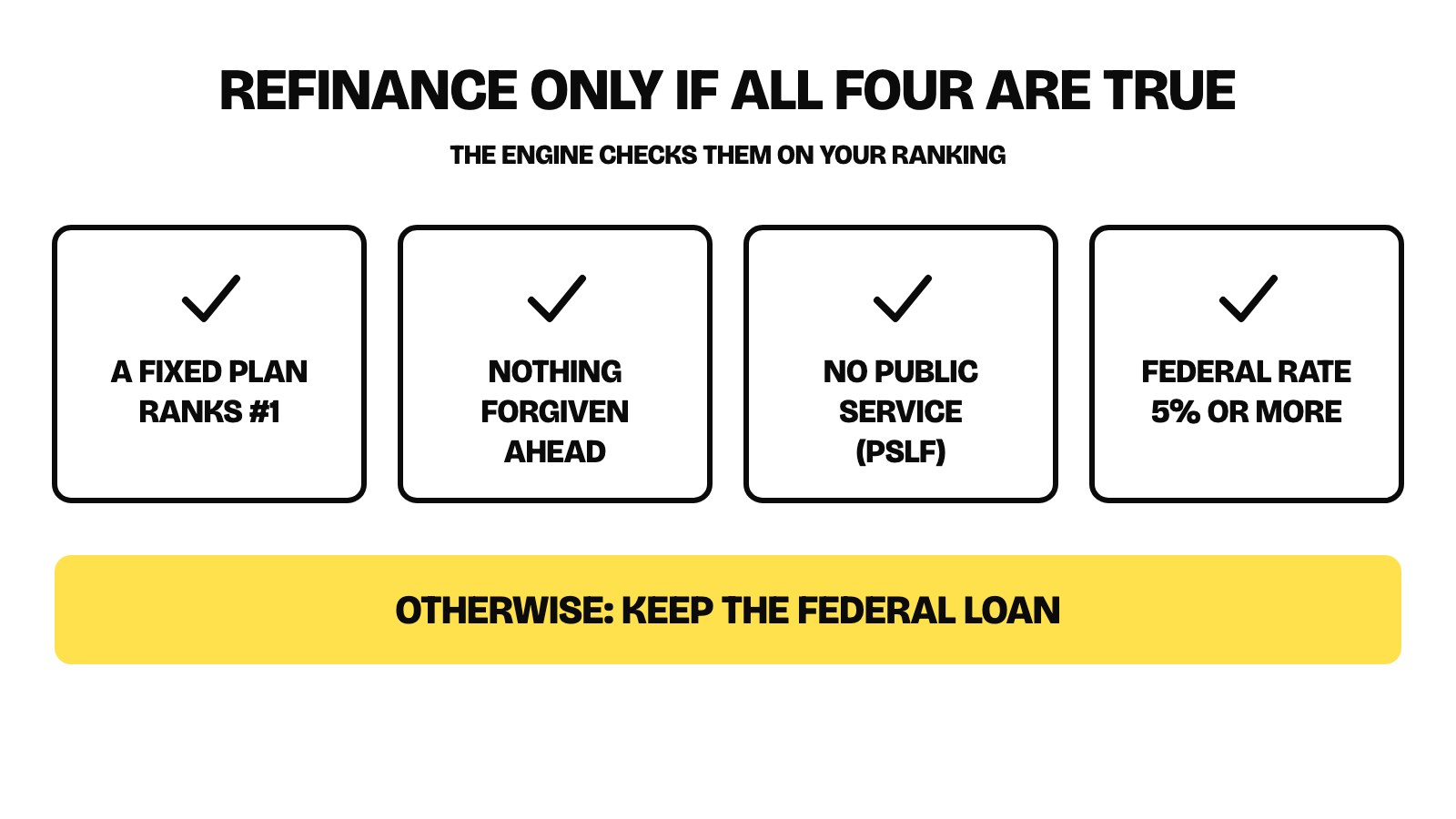
- A fixed plan ranks first
- When the 10-year Standard plan (or another fixed plan) is your cheapest choice all in, you were going to pay the whole balance anyway. Then, and only then, a lower rate is the last lever left.
- Nothing is forgiven ahead
- If your #1 plan ends with a forgiven balance (IBR after 20 or 25 years, RAP after 30), the forgiveness is the plan. A private loan has none.
- No public service
- PSLF needs federal Direct Loans. Refinance and every payment you counted toward the 120 stays behind on a loan you no longer have (34 CFR 685.219).
- Federal rate at 5% or more
- Below that, a private fixed rate rarely beats it once fees and the lost protections are counted. Most federal loans from 2022 onward sit above it (undergraduate 6.52%, graduate 8.07%, PLUS 9.07% for 2026-27).
Six borrowers, the rule applied
The same engine that ranks your plans runs the rule on each ranking. Single, first loan after 2014, 6.5%, income rising 3% a year with the poverty line following the CBO inflation forecast (the studentaid.gov calculator's assumptions), and a 22% tax on any taxable forgiveness. Monthly figures are the first year: income-driven payments are recalculated from income every year, Graduated steps up every two years, Standard and Extended stay fixed.
| Borrower | #1 plan | Refinance? | What the engine tells them |
|---|---|---|---|
| $38,000 income, $27,000 in loans | Standard 10-year | It can win | Your #1 plan is Standard 10-year, you are not in public service, and nothing in your plan is forgiven. You would pay the $27,000 in full either way, so a lower fixed rate is the only lever left: on your balance at 6.50%, each point off the rate saves about $1,627 over ten years. |
| $46,000 income, $58,000 in loans | Income-Based Repayment | No | Your #1 plan is Income-Based Repayment (IBR), which ends with $70,069 forgiven. A private loan has no forgiveness, so it costs you the very thing your #1 plan is built on. |
| $55,000 income, $48,000 in loans | Standard 10-year | It can win | Your #1 plan is Standard 10-year, you are not in public service, and nothing in your plan is forgiven. You would pay the $48,000 in full either way, so a lower fixed rate is the only lever left: on your balance at 6.50%, each point off the rate saves about $2,892 over ten years. |
| $85,000 income, $95,000 in loans | Standard 10-year | It can win | Your #1 plan is Standard 10-year, you are not in public service, and nothing in your plan is forgiven. You would pay the $95,000 in full either way, so a lower fixed rate is the only lever left: on your balance at 6.50%, each point off the rate saves about $5,725 over ten years. |
| $30,000 income, $38,000 in loans | Income-Based Repayment | No | Your #1 plan is Income-Based Repayment (IBR), which ends with $67,062 forgiven. A private loan has no forgiveness, so it costs you the very thing your #1 plan is built on. |
| $55,000 income, $48,000 in loans, public service with 40 PSLF payments made | Repayment Assistance Plan | No | A private loan ends your PSLF count for good. Every payment you have made toward the 120 stays behind on the federal loan you no longer have. |
What one point of rate is worth
On a 10-year payoff, each point off the rate saves this much over the life of the loan. The federal rates are the 2026-27 fixed rates; the best private fixed rates listed by Credible, SoFi and Earnest start near 4% for the strongest credit (September 2026), and most borrowers are offered more.
| Federal loan | $25,000 balance | $50,000 balance | $100,000 balance |
|---|---|---|---|
| Undergraduate Direct loan, 2026-27, 6.52% | $1,507 per point | $3,015 per point | $6,029 per point |
| Graduate unsubsidized, 2026-27, 8.07% | $1,568 per point | $3,137 per point | $6,274 per point |
| PLUS (grad or parent), 2026-27, 9.07% | $1,607 per point | $3,214 per point | $6,429 per point |
Level 10-year payments before and after a one-point cut, no fees. A two-point cut saves about twice this; a longer private term lowers the payment and raises the total, which is the trade to watch.
What you give up, exactly
Income-driven payments
IBR and RAP size the bill to your income and family, and drop it when income falls. A private loan is a fixed schedule whatever happens to your income (34 CFR 685.209).
Forgiveness
IBR after 20 or 25 years, RAP after 30, PSLF after 120 qualifying payments. None of it exists on a private loan, and the months you already counted do not transfer.
Federal deferment and forbearance
Unemployment and hardship deferments, and forbearance, are federal rights on federal loans (34 CFR 685.204, 685.205). Private lenders offer what they choose, if anything.
Federal discharges
Discharge on death or total and permanent disability is written into the federal loan (34 CFR 685.212). Some private lenders offer a version; many do not.
If the rule says yes, how to do it without a mistake
- Prequalify at two or three lenders first. A prequalification is a soft credit pull and shows a real rate; only a full application is a hard pull.
- Compare the fixed rate and the term, not the payment. A lower payment from a longer term costs more in total; take the shortest term you can carry.
- Refinance only the loans that lose. You can refinance a high-rate graduate or PLUS loan and leave the rest federal; the rule is per loan, not per person.
- Pick your federal plan anyway, before the 90 days end. The refinance takes weeks; if it falls through, you do not want to be sitting on the default plan by accident.
- Any doubt about your income, stop. The protections you give up are worth the most to the people who cannot predict next year.
Questions
- I have good credit and a high income. Is that enough?
- Only if the four conditions hold. A high earner heading for PSLF should never refinance; a high earner with no forgiveness ahead and an 8% graduate loan usually should look.
- Can I refinance and keep PSLF?
- No. PSLF is a Direct Loan program; a private loan is not a Direct Loan, and refinancing pays the federal loan off. The count ends there.
- Does the free ranking tell me?
- Yes. Every results page carries this rule applied to your own ranking, in plain words: whether refinancing can win for you, and if not, why not. No lender pays for a place on this page; the rule is the engine's.

See whether refinancing can win for you, on your numbers.
Ten questions rank every federal plan on your income and loans, then apply this rule to your ranking. The free result says yes or no and why; the kit adds the switching guide and the pre-filled form for the federal plan, $29.
Rank my plans, freeSources
- Repayment plans Federal Student Aid
- 34 CFR 685.209, income-driven repayment plans Code of Federal Regulations
- Public Service Loan Forgiveness Federal Student Aid
- 34 CFR 685.212, discharge of a loan obligation (death, disability, other federal discharges) eCFR
- Student loan repayment plans: what are your options now (2026-27 federal rates, refinancing) CNBC Select
- Best student loan refinance rates and bonuses (lender fixed-rate ranges, September 2026) Student Loan Planner
- Public Law 119-21, the 2025 reconciliation act (student loan title) Congress.gov