New, since July 1, 2026
Repayment Assistance Plan (RAP)
The new income-driven plan: a share of your whole income, unpaid interest waived, forgiveness after 30 years.
See where it ranks for you, free Two minutes, your own numbers, every plan side by side.
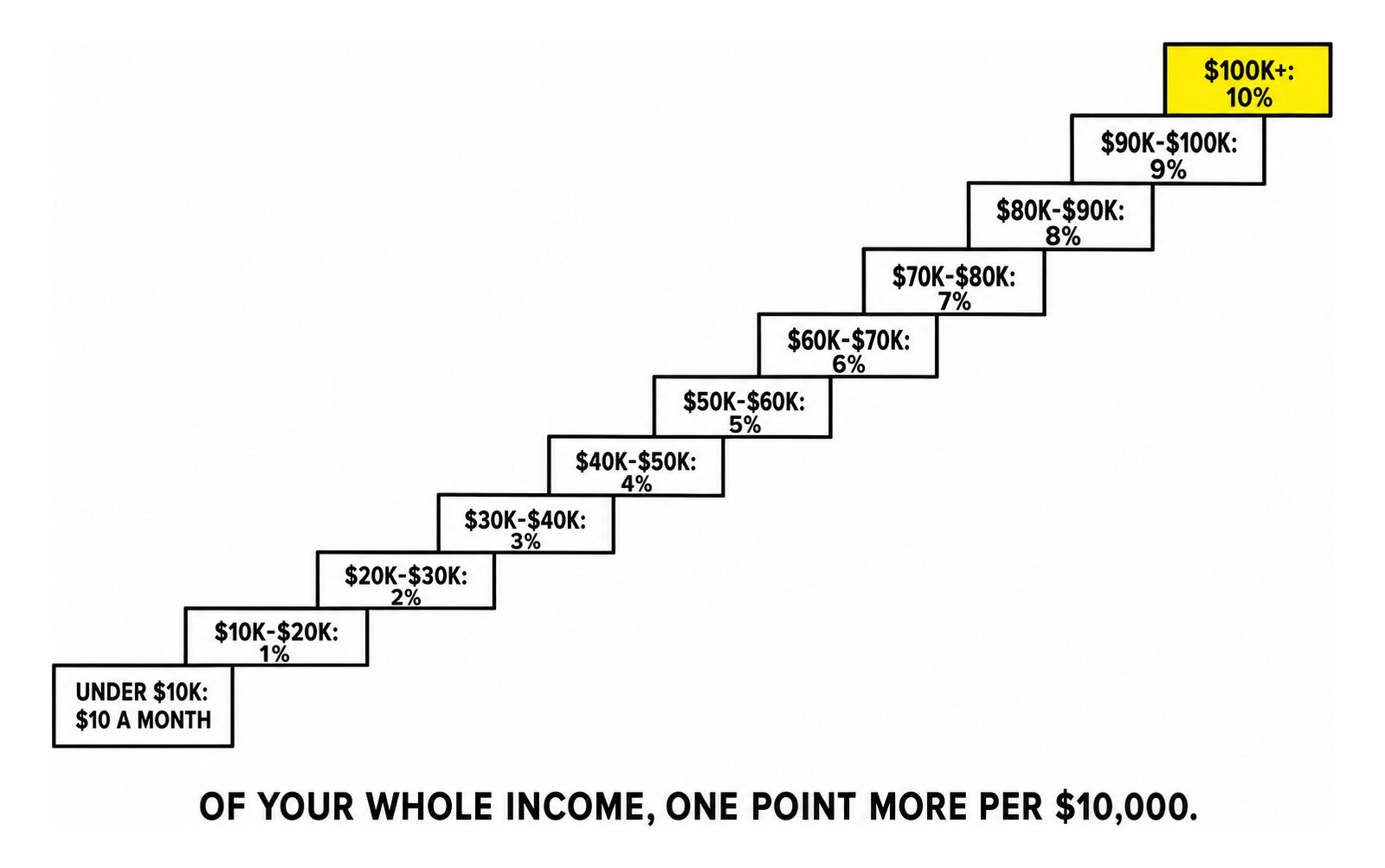
- Payment
- A share of your adjusted gross income, not of discretionary income: 1% for AGI between $10,001 and $20,000, then one point more for each $10,000 bracket, up to 10% above $100,000. AGI at or under $10,000 pays $10. Subtract $50 a month for each dependent child. Never under $10. Married filing separately counts only your AGI, not your spouse's; filing jointly counts both incomes.
- Who qualifies
- Direct Loans, including Direct Consolidation Loans. FFEL and Perkins loans must be consolidated first. Parent PLUS loans and consolidation loans that repaid Parent PLUS are excluded. For any loan made on or after July 1, 2026 it is the only income-driven plan.
- Forgiveness
- The remaining balance is forgiven after 360 qualifying payments, 30 years. Months in RAP do not count toward IBR's 20 or 25 year forgiveness if you later switch.
- Interest
- Interest your payment does not cover is not charged; it is never added to your balance. If your payment reduces principal by less than $50, the Department tops it up so at least $50 goes to principal each month you pay in full.
- PSLF
- Qualifies. Every on-time payment counts toward the 120.
- Taxes
- Forgiveness after 30 years is taxable federal income in the year it happens, under the law since January 1, 2026. PSLF forgiveness is not.
- How to apply
- Online at studentaid.gov/idr with your FSA ID; the IDR Plan Request covers RAP, IBR, PAYE and ICR. Consent to the IRS data share for faster processing and automatic recertification. The paper form has no RAP box yet, so choose it online.
- Leaving it
- If every loan you have was made before July 1, 2026, you can move to IBR later. A new loan or a new consolidation on or after that date closes IBR for good.
- Dates
- Available since July 1, 2026. No end date.
Good for
- A balance that would otherwise grow: the interest waiver stops it
- Households with dependent children
- Middle incomes with large balances, where the AGI formula beats 10% of discretionary income
Watch out
- No cap: above roughly $100,000 of income the payment can exceed the 10-year Standard amount, where IBR would cap it
- A 30-year clock, ten years longer than new-borrower IBR
- Time in RAP does not count toward IBR's forgiveness clock
Questions people ask about RAP
- Is RAP better than IBR?
- It depends on your income and balance. RAP takes 1% to 10% of your whole adjusted gross income with no cap; IBR takes 10% of the income above 150% of the poverty line and never more than the 10-year Standard payment. Above roughly $100,000 of income, or with a balance you could clear in ten years, IBR or Standard usually costs less all in. The free ranking runs both on your numbers.
- What is the smallest RAP payment?
- $10 a month. An adjusted gross income of $10,000 or less pays the flat $10; each dependent child takes $50 off the monthly amount, and the payment never goes below $10.
- Can I apply for RAP now?
- Yes, since July 1, 2026, online at studentaid.gov/idr through the IDR Plan Request. The paper form has no RAP box yet, so choose it online. Consent to the IRS data share and your income is pulled from your return every year without another form.
- Does RAP forgive the balance?
- After 360 qualifying payments, 30 years. What is forgiven is taxable federal income in that year under the law in force since January 1, 2026; PSLF forgiveness is not taxed.
- Does unpaid interest pile up on RAP?
- No. Interest your payment does not cover is not charged and is never added to your balance, and if less than $50 of a full payment reaches principal the Department tops it up to $50.
- Does RAP count toward PSLF?
- Yes. Every on-time RAP payment counts toward the 120. Late payments do not, and months in a forbearance cannot be bought back on RAP.
- Can I switch from RAP to IBR later?
- Only if every loan you have was made before July 1, 2026. A new loan or a new consolidation on or after that date closes IBR for good. Months spent on RAP do not count toward IBR's 20 or 25 year forgiveness.
- Are Parent PLUS loans eligible?
- No. Parent PLUS loans, and consolidation loans that repaid Parent PLUS, are excluded from RAP. Consolidated Parent PLUS loans use ICR until it closes, or IBR where the rules allow.
- How is RAP different from SAVE?
- SAVE charged a share of the income above a poverty allowance and waived unpaid interest; the courts blocked it and it is being wound down. RAP charges a share of your whole income, also waives unpaid interest, and runs a 30-year clock instead of 20 or 25.
- What happens when my income changes?
- The payment is recalculated every year from your latest tax return. Filing separately counts only your income; filing jointly counts both, and when both spouses have federal loans the payment is split in proportion to the balances.

Where RAP lands for you depends on your numbers.
Right Repay runs every plan on your income, household, balance and loan dates, ranks them on all-in cost, and shows the math. Every position is free, with the math; the kit to switch is $29.
Rank my plans, freeSources
- The Repayment Assistance Plan, In Focus IF13075 Congressional Research Service
- Public Law 119-21, the 2025 reconciliation act (student loan title) Congress.gov
- Income-driven repayment plans Federal Student Aid
- Top FAQs about income-driven repayment plans Federal Student Aid
- The IDR Plan Request application Federal Student Aid
- IBR vs. RAP: key differences AccessLex Institute
- IBR vs RAP Tate Law
- Switching between IBR and RAP Tate Law
Which plan is right for you depends on your income, your balance and your loans' dates.
Rank every plan for me, freeThe other plans
- Income-Based Repayment (IBR)Open, permanent for loans made before July 2026
- Standard 10-yearThe default when you choose nothing
- Graduated 10-yearOpen
- Extended 25-yearOpen, for more than $30,000 in Direct Loans
- Pay As You Earn (PAYE)Closing: ends by July 1, 2028
- Income-Contingent Repayment (ICR)Closing: ends by July 1, 2028
- Tiered StandardNew, for loans made on or after July 1, 2026
Guides
- SAVE is ending: what to do in your 90 daysThe dates, the options, what the default costs
- RAP vs IBRRule by rule, with numbers for four borrowers
- PSLF and the SAVE exitWhich plans count, which to pick
- Married: file jointly or separatelyThe same couple, both ways
- Parent PLUS loansWhat is still open, what consolidating changes
- Your servicer's noticeMOHELA, Nelnet, Aidvantage, Edfinancial
- How the ranking worksThe rules, the math, what it assumes, what it never does
- RAP calculatorThe formula, the brackets, four borrowers' payments
- IBR calculatorDiscretionary income, the 10% or 15%, the cap
- IDR calculator, every planRAP, IBR, PAYE and ICR on the same income
- Forgiveness in 2026What is left, when it comes, who pays the tax
- The best repayment planRanked for four borrowers, and what the default costs
- How to apply for RAPWhat to have ready, the screens, the answers