Open, permanent for loans made before July 2026
Income-Based Repayment (IBR)
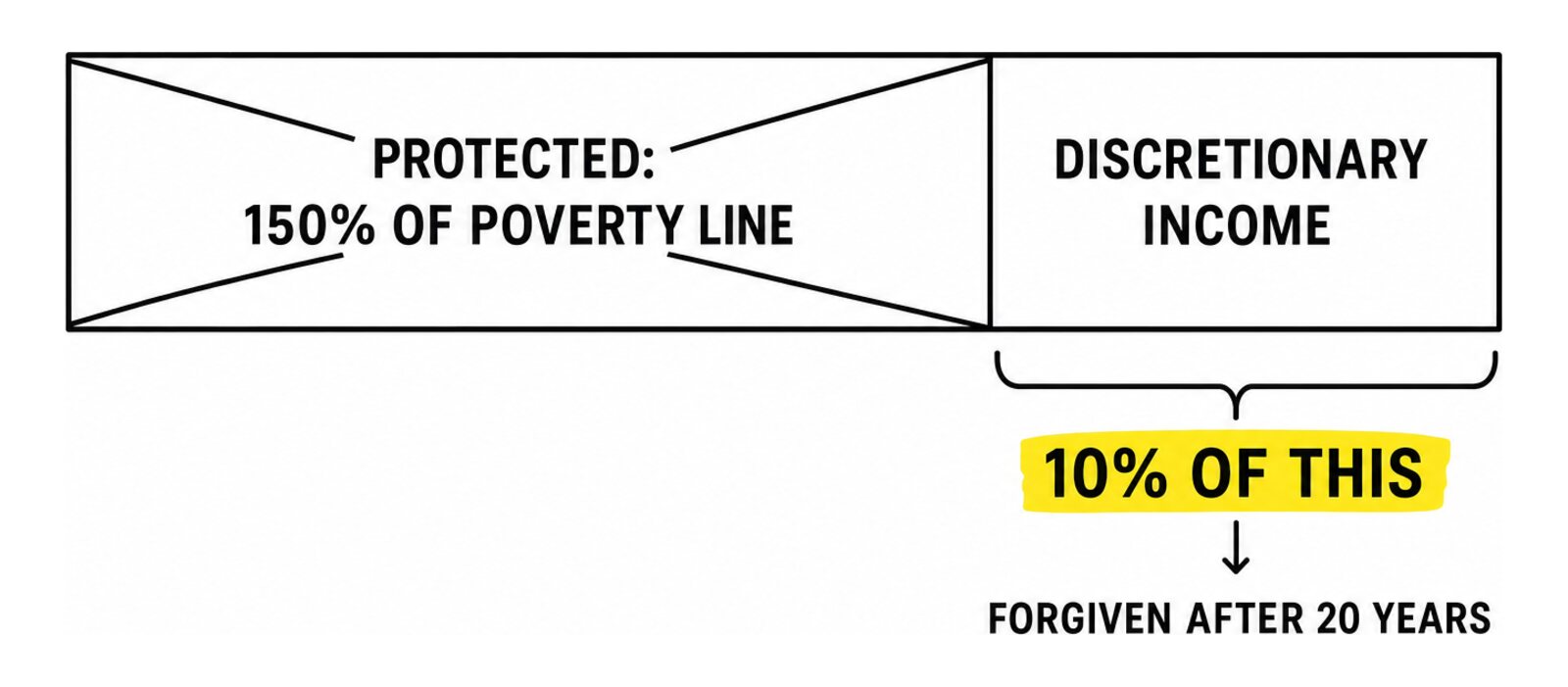
10% or 15% of discretionary income, capped at the Standard payment, forgiveness after 20 or 25 years.
See where it ranks for you, free Two minutes, your own numbers, every plan side by side.
- Payment
- 10% of discretionary income if your first federal loan was made on or after July 1, 2014 ("new borrower" IBR), 15% if earlier. Discretionary income is adjusted gross income minus 150% of the poverty guideline for your family size. The payment never exceeds the 10-year Standard amount set when you enroll. Married filing separately counts only your income, not your spouse's; filing jointly counts both.
- Who qualifies
- Direct and FFEL loans made before July 1, 2026. The partial financial hardship test was removed by the 2025 law, so nearly everyone with eligible loans qualifies, though some servicer tools still show "not eligible"; the paper form is the way through when that happens. Parent PLUS loans are excluded. A new loan or consolidation on or after July 1, 2026 removes IBR access.
- Forgiveness
- After 20 years of qualifying payments for new borrowers, 25 for earlier borrowers. Earlier payments under IBR, PAYE, ICR and SAVE count. Months in RAP do not.
- Interest
- For the first three years, unpaid interest on subsidized loans is covered by the government. Other unpaid interest accrues but is not capitalized while you stay in IBR. Leaving IBR for another plan capitalizes it once.
- PSLF
- Qualifies.
- Taxes
- Forgiveness after 20 or 25 years is taxable federal income from 2026. PSLF forgiveness is not.
- How to apply
- Online at studentaid.gov/idr. Choose IBR by name; "the plan with the lowest payment" lets the servicer choose. Consent to the IRS data share.
- Leaving it
- Moving from the SAVE forbearance into IBR does not capitalize interest. Moving out of IBR later does, once. You can move to RAP if your loans predate July 2026.
- Dates
- No sunset for loans made before July 1, 2026.
Good for
- Higher earners: the Standard-payment cap limits what you pay
- Borrowers close to 20 or 25 years of income-driven payments
- Anyone who wants the option to switch to RAP later
Watch out
- Unpaid interest accrues (except subsidized loans for three years)
- Leaving IBR capitalizes unpaid interest once
- The 15% version and 25-year clock for loans before July 2014

Where IBR lands for you depends on your numbers.
Right Repay runs every plan on your income, household, balance and loan dates, ranks them on all-in cost, and shows the math. Every position is free, with the math; the kit to switch is $29.
Rank my plans, freeSources
- 34 CFR 685.209, income-driven repayment plans Code of Federal Regulations
- Income-driven repayment plans Federal Student Aid
- Top FAQs about income-driven repayment plans Federal Student Aid
- IDR Plan Request, official PDF (OMB 1845-0102) Federal Student Aid
- IBR vs. RAP: key differences AccessLex Institute
- IBR vs RAP Tate Law
- Income-driven repayment Student Loan Borrower Assistance (NCLC)
Which plan is right for you depends on your income, your balance and your loans' dates.
Rank every plan for me, freeThe other plans
- Repayment Assistance Plan (RAP)New, since July 1, 2026
- Standard 10-yearThe default when you choose nothing
- Graduated 10-yearOpen
- Extended 25-yearOpen, for more than $30,000 in Direct Loans
- Pay As You Earn (PAYE)Closing: ends by July 1, 2028
- Income-Contingent Repayment (ICR)Closing: ends by July 1, 2028
- Tiered StandardNew, for loans made on or after July 1, 2026
Guides
- SAVE is ending: what to do in your 90 daysThe dates, the options, what the default costs
- RAP vs IBRRule by rule, with numbers for four borrowers
- PSLF and the SAVE exitWhich plans count, which to pick
- Married: file jointly or separatelyThe same couple, both ways
- Parent PLUS loansWhat is still open, what consolidating changes
- Your servicer's noticeMOHELA, Nelnet, Aidvantage, Edfinancial
- How the ranking worksThe rules, the math, what it assumes, what it never does
- RAP calculatorThe formula, the brackets, four borrowers' payments
- IBR calculatorDiscretionary income, the 10% or 15%, the cap
- IDR calculator, every planRAP, IBR, PAYE and ICR on the same income
- Forgiveness in 2026What is left, when it comes, who pays the tax
- The best repayment planRanked for four borrowers, and what the default costs
- How to apply for RAPWhat to have ready, the screens, the answers